

So the official numbers dropped. And they’re a doozy.
The UK just added three-quarters of a million people in a single year. 755,254, to be exact. That’s not a rounding error. That’s the entire population of Leeds, one of the UK's biggest cities, materializing out of thin air between one summer and the next.
Just picture it. A whole new Leeds. The traffic, the housing, the doctors' appointments, the sheer number of people needing a pint on a Friday night. Now drop that on top of a country that already feels like it's bursting at the seams.
And the official report from the stats nerds presents this with the same dry enthusiasm as a weather forecast. "Net international migration was the primary driver," it says.
Let's deconstruct that sterile little phrase, shall we? "Net international migration." It sounds so clean, so manageable, like something you’d track on a spreadsheet. But it’s not. It’s the chaotic, messy, human reality of 1,235,254 people arriving while 496,536 people are leaving. That’s nearly 1.75 million people in transit, their lives packed into suitcases, all happening in 365 days. It's a firehose of demographic change, and they’re reporting it like a dripping tap.
This is a massive demographic event. No, 'massive' doesn't cover it—this is a five-alarm national realignment happening in real-time. We’re told this is the second-largest annual jump since 1949. You know, right after a world war. What’s our excuse?
But here’s the kicker. Here’s the part of the story that really gets me.
While the country is absorbing a population the size of a major city through immigration, the number of babies being born just hit the lowest point in at least 42 years.
Read that again. The lowest number of births in over four decades.
So on one hand, you have this unprecedented influx. On the other, you have the existing population apparently deciding, en masse, that this ain't the right time or place to bring a kid into the world. What does that tell you? It tells me that people are looking at the cost of living, the price of a shoebox-sized apartment, the general state of things, and saying, "No, thanks." It’s a vote of no confidence delivered in empty maternity wards.
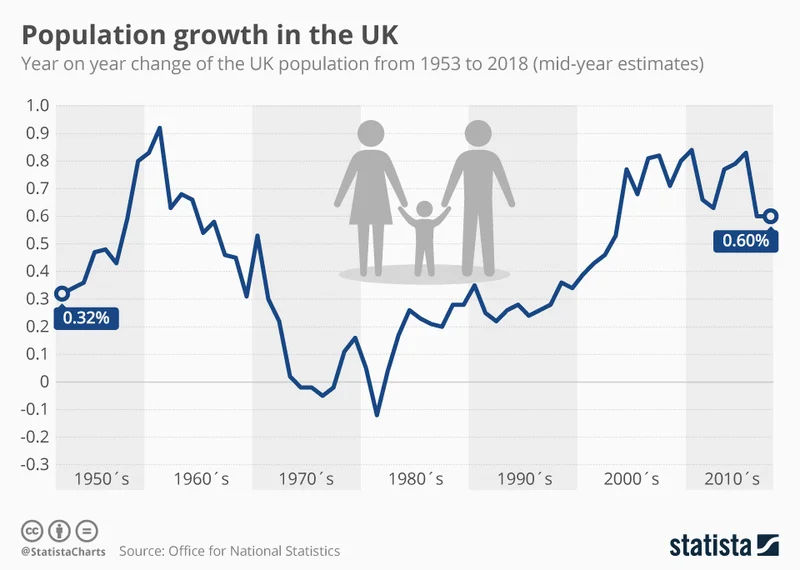
The official story is one of growth. The UK population growth rate is up, headline secured. But it feels more like a story of replacement, or at least radical transformation. The country is changing at a fundamental level, and the people in charge are just... counting.
And it’s not happening evenly. England's population shot up by 1.2%. Meanwhile, you look at Scotland and Wales, and they both recorded more deaths than births. Think about that. Without migration, those parts of the UK are literally shrinking. I took a train to Cardiff once—cost a fortune, by the way, don't get me started on UK rail fares—and you could feel it. A sense of things being older, quieter. Now the numbers back it up. The ONS says their populations are older and have lower birth rates. Offcourse they do.
So what we have is a country that is simultaneously aging and getting younger, shrinking and exploding, all at the same time. It’s a paradox held together by spreadsheets.
And nobody seems to be asking the obvious questions. Where are the 755,000 extra people living? Are we building a Leeds-worth of new houses every year? A Leeds-worth of new schools and hospital wards? I haven't seen them. Have you? The system already feels like it's groaning under the strain. This isn't a political point; it's a simple logistical one. You can't just keep adding people to a finite space with finite resources and expect everything to just… work.
The government will tell you this is all part of a plan for economic growth, and you just have to wonder...
They’ve been saying that since the turn of the century, apparently, as migration has been the main driver of growth for two decades. Has it worked? Are we all richer? Is everything running more smoothly?
I look at these numbers, and I don't see a plan. I see chaos being reported as data. I see a country undergoing a change so profound and so rapid that nobody has the guts to talk about what it actually means. Not for the economy in the abstract, but for the lives of the 69.3 million people who have to navigate the reality of it every single day.
Then again, maybe I'm the crazy one here. Maybe this is just the 21st century and I'm a dinosaur yelling about numbers on a screen. This is just how it is now. A constant, massive churn.
Get used to it, I guess.
Running the Numbers on a Fever Dream ###
Let's be real. They're not managing population growth; they're documenting a tidal wave from a deck chair and calling it a strategy. This isn't a plan. It's a national experiment being conducted without a hypothesis, and we're all the lab rats.
Reference article source:
- UK population records second largest annual increase in 75 years
- UK records second biggest annual population jump in 75 years
- Migration pushes UK population to second biggest annual rise in 75 years
Tags: uk population growth