

The spectacle in University Park on September 27th was, by all accounts, an operational success. Over one hundred thousand spectators, coordinated in white, generated an acoustic environment designed for maximum disruption. The television broadcast captured the requisite panoramic shots. For a time, the home team, Penn State, even appeared to overcome an early 17-3 deficit, forcing overtime against the visiting No. 6 Oregon Ducks. The event produced a final score—Oregon 30, Penn State 24—and a series of video clips suitable for future promotional packages.
Online sentiment, a qualitative data set I find useful for gauging initial market reaction, immediately labeled the contest an "instant Big Ten classic." It was a "thrilling" showdown. The narrative was one of a valiant effort that fell just short.
This is the noise. The signal is something else entirely. The signal suggests that what occurred in Beaver Stadium was not a classic, nor was it a thriller. It was a regression. It was the latest, and perhaps most predictable, data point in a long-term analysis of a program's performance ceiling.
More Than a Loss: A Regression to the Mean
Evaluating the Asset
To understand the outcome, one must disregard the immediate emotional inputs—the comeback, the double-overtime, the sheer volume of the crowd. These are confounding variables. The core task is to analyze the underlying performance metrics of the asset in question: Penn State football under head coach James Franklin, specifically in high-stakes scenarios.
The data is unambiguous. With this loss, Franklin’s career record against AP Top-10 opponents fell. It's a poor record, with about 4 wins in 25 tries—to be more exact, a 4-21 record. The resolution sharpens when the opponent’s rank is higher. Against AP Top-6 teams, the sample from which Oregon was drawn, Franklin’s record is now 2-21. This most recent loss extends a losing streak against this cohort to 15 consecutive games, a streak dating back to 2016.
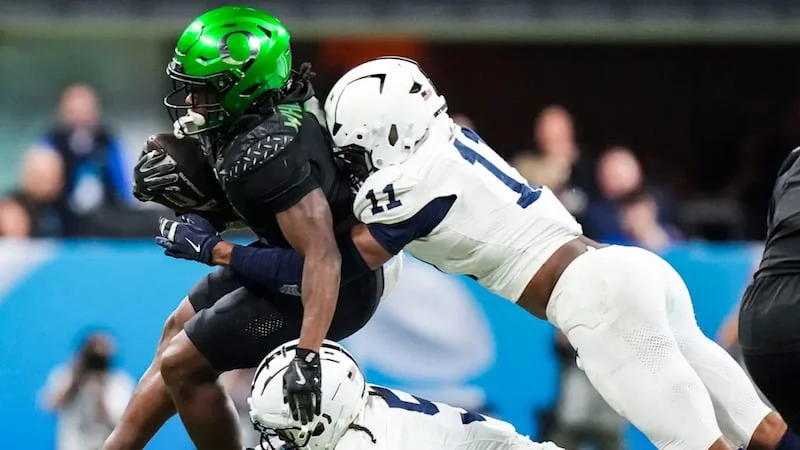
The quarterback, Drew Allar, is a dependent variable in this equation. His own record as a starter against AP Top-6 opponents is now 0-6. This is not an indictment of a single player but a confirmation of a systemic condition. The system he operates within has not historically produced wins in these scenarios, and his individual performance correlates perfectly with that established trend. His game-ending interception in the second overtime was not a moment of isolated failure; it was the system executing its most probable outcome under pressure.
I've looked at hundreds of performance charts for organizations over the years, and this particular pattern is unusual. It's rare to see an entity perform so consistently at one level (winning against unranked or lower-ranked opponents) and then demonstrate such a predictable, catastrophic failure rate when the opposition's quality crosses a specific, high-level threshold. The discrepancy isn't just a trend; it's a statistical cliff.
The control group in this experiment was Oregon. Coach Dan Lanning secured his first-ever ranked road win. His program has now won 17 consecutive conference games (a perfect 11-0 since joining the Big Ten). This was their third straight victory against an AP Top-5 team, a first in school history. Oregon’s metrics trend upward. They executed with brutal efficiency, possessing the ball for over 33 minutes and holding their quarterback, Dante Moore, to a clean sheet with no interceptions against three touchdowns. They behaved like a team that expected to win. Their victory wasn't an upset; it was an execution of their business plan.
One analyst described the loss as a "Groundhog Day" scenario for Penn State. This is an accurate, if emotionally charged, assessment. But from a purely analytical perspective, it's simpler than that. A model fed with the historical data—Penn State's 14-game losing streak against the Top-6, Franklin's 2-20 record, Allar's 0-5 record entering the game—would not have predicted a different outcome. The model would have seen the 17-3 deficit not as a hole, but as the initial drift toward the mean. It would have seen the comeback and overtime as volatility, not a fundamental shift in the asset's value.
The final score was the model correcting itself. The noise of 100,000 fans and the drama of a comeback could not alter the fundamental equation. The numbers that defined the program before kickoff were the same numbers that defined it after the final pass was intercepted. Nothing had changed.
The Terminal Velocity of a Program
The prevailing narrative is that Penn State is perpetually on the cusp of breaking through. The data suggests this is a fundamental misreading of the situation. The program is not accelerating toward a breakthrough. It has reached its terminal velocity. The performance against Oregon was not an anomaly; it was a perfect representation of the program's established ceiling under its current leadership. The "White Out" is a magnificent piece of marketing for a product that has a clearly defined, and limited, performance cap in high-pressure markets. The asset is stable, profitable against lesser competition, but has demonstrated no capacity for growth in the top tier.
Reference article source:
- Oregon vs. Penn State FREE LIVE STREAM (9/27/25): Watch college football, Week 5 online | Time, TV channel
- Penn State faces Groundhog Day as Oregon, Alabama ace tests: College football Week 5 takeaways
- Oregon escapes Penn State in double-OT: No. 6 Ducks blow lead, finish strong vs. James Franklin, Nittany Lions
Tags: penn state oregon