

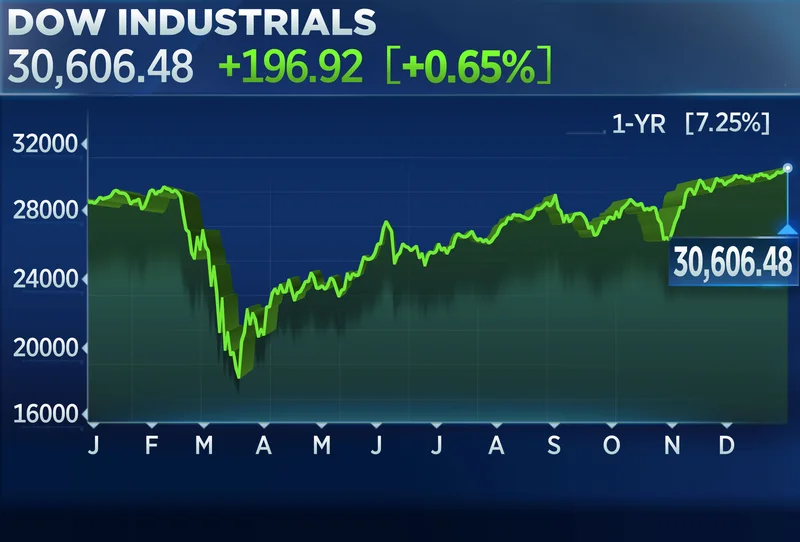
The Dow Jones stock markets today are painting a picture of resolute optimism. The S&P 500 just capped a "perfect week," stringing together six straight days of gains to close at a fresh high. The Dow Jones Industrial Average added another 239 points, also hitting a new record. On the surface, it’s a scene of champagne flutes and confident traders, a market that seems to have put any and all worries in the rearview mirror.
But when you mute the celebratory noise from the trading floor and look at the actual data scrolling across the screen, a different narrative emerges. It’s a quieter, more unsettling story—one that suggests the market's foundation might not be as solid as the record highs imply. The disconnect between market sentiment and underlying economic signals is becoming too significant to ignore.
The Shutdown Anomaly
The most immediate and obvious contradiction is Wall Street’s complete indifference to the federal government shutdown 2025, which just entered its third day. Historically, shutdowns inject a dose of volatility and uncertainty into the markets, a recurring theme when it comes to Shutdowns and market highs: The top 3 questions investors are asking now. They represent a failure of political process, which is rarely a bullish signal. Yet, this time, the big three indexes actually touched intraday records during the shutdown. This isn't just resilience; it borders on denial.
The market seems to be operating on a powerful anesthetic, numb to the very real consequences of shuttered government agencies. The most critical of these is the delay of the official September jobs report unemployment numbers from the Labor Department. This is the benchmark data set for the health of the American labor market. Without it, investors are flying partially blind. What data did we get instead? The ADP private payrolls report, which showed a loss of 32,000 jobs. A negative print, even from a secondary source, should have at least given the bulls pause. It didn’t.
This behavior is like a pilot confidently announcing a smooth flight while ignoring the fact that the cockpit's main navigation screen has gone dark. He might have a secondary compass, and it might be pointing in a vaguely reassuring direction, but the primary, most reliable instrument is offline. Why is no one concerned that we’re navigating one of the most complex economic environments in recent memory with incomplete information? Is the market’s faith in a quick resolution so absolute that it's willing to price in a perfect outcome before it even happens?
The Stagnation Signal
If the missing jobs report is a known unknown, the data we did receive on Friday should have been a clear warning. The Institute for Supply Management’s (ISM) services sector survey was the main event, and its reading was anything but celebratory. The index fell to a flat 50.0, down from expectations of 52. (Any reading below 50 signals contraction, a critical threshold). The economy’s largest sector has effectively stalled. It has stopped expanding.
Let that sink in. While the u.s. stock market today was printing new highs, the engine of the U.S. economy was sputtering to a halt. Digging into the report only makes it worse. Bill Adams, the chief economist at Comerica Bank, noted that a majority of respondents in both the services and manufacturing PMI surveys reported that they had trimmed headcount in September. This isn't a forecast or a projection; this is what businesses are actively doing right now. They are cutting staff.
I've analyzed hundreds of these PMI reports, and seeing both the manufacturing and services surveys indicate trimmed headcount simultaneously is a particularly loud alarm bell that the market seems to have on mute. This isn't just a tech story, where high-flyers like Palantir and Tesla saw a minor pullback that dragged on the Nasdaq. This is broad-based weakness.
It brings to mind the curious case of Target. The retail giant's stock has plummeted about 40% over the past year—to be more exact, it’s been in a confirmed bear market while the S&P 500 climbed 15%. Target’s struggles, stemming from shrinking sales and a difficult turnaround, are a reflection of a strained consumer. While it may be an outlier in its sector, it’s also a canary in the coal mine for Main Street. How can the broader market be so euphoric when a bellwether for American consumption is sending such dire signals?
An Unsettling Divergence
My analysis suggests we are witnessing a dangerous divergence. The market's price action is telling one story, driven by momentum and a seemingly unshakable faith that any problem—be it a shutdown or weakening economy—is temporary. But the data is telling a completely different story. It speaks of job losses, economic stagnation, and weakening consumer-facing businesses. One of these narratives is wrong. And while betting against a runaway bull market is a fool's errand in the short term, betting that underlying economic reality won't eventually matter is a far greater risk. The numbers aren't whispering caution; at this point, they're screaming it.
Tags: dow jones stock markets