

You’re sitting in your favorite restaurant, maybe grabbing a cookie from Crumbl after seeing their logo zip around a NASCAR track. You order, the food arrives, and you enjoy it without a second thought for the colossal, near-invisible system that made it possible. We live our lives on the surface of an ocean of logistics, a complex web of supply chains so vast and efficient that it feels like magic.
But it isn’t magic. It’s a system. And right now, in Portland, Oregon, a critical part of that system is sending a tremor through the entire network.
The 270 Teamsters at Sysco Portland—the drivers, warehouse workers, and mechanics who are the literal hands of this logistical giant—have voted to authorize a strike. And the number that should make everyone, from Wall Street analysts to local diner owners, sit up and pay attention is 99.5 percent. That’s the margin by which they agreed to walk off the job if Sysco, a corporation that netted nearly $2 billion in profit last year, doesn’t offer them a fair contract. (Teamsters at Sysco Portland Authorize Strike)
This isn't just another labor dispute. I see this as something far more profound. This is a stress test of the very architecture of our modern economy. It’s a story about the friction between our hyper-efficient, data-driven corporate machines and the indispensable, irreplaceable human element that keeps them running. What happens when the ghost in the machine decides it deserves a voice?
The Anatomy of an Invisible Empire
To understand what’s at stake, you first have to appreciate the sheer scale of what Sysco is. Think of it not as a company, but as the circulatory system of America’s food-away-from-home economy. We're talking about a logistical ballet of staggering complexity—a network of 337 distribution centers, 75,000 people, and a fleet of trucks moving everything from Heinz ketchup for a NASCAR race to the fresh produce for a five-star restaurant, all generating over $81 billion in annual sales. It's the kind of system that, when it works, is utterly invisible. It’s the quiet hum behind every meal you don’t cook yourself.
Wall Street loves this hum. Analysts are overwhelmingly rating the stock a "Buy." Hedge funds are pouring in millions. The company is confidently scheduling its Q1 earnings call for late October, ready to showcase its financial health. (Sysco Corporation to Host Conference Call for Q1 Fiscal Year 2026 Financial Results on October 28, 2025) From the 30,000-foot view of an investor report, everything looks perfect. The machine is optimized, the profits are growing, and the future EPS guidance is strong.
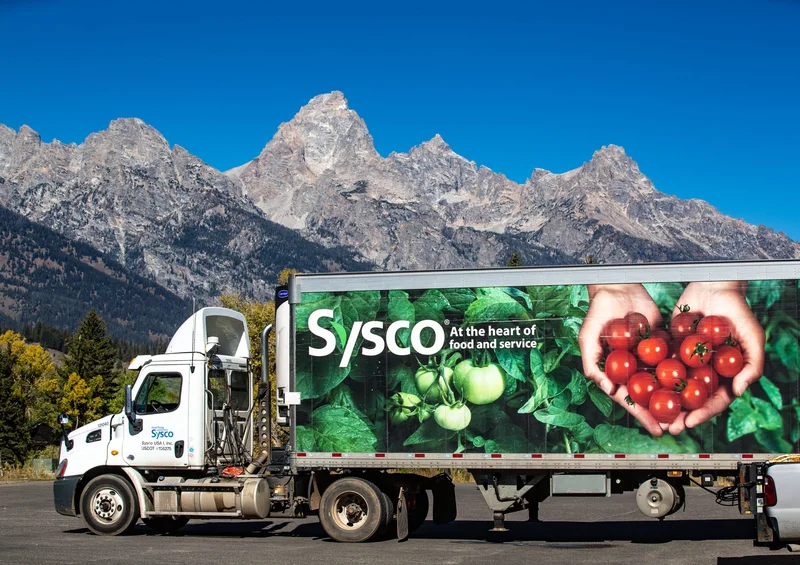
But zoom in from that satellite view, down to the loading dock of a distribution center in Portland on a cold morning. The people there aren't abstract "human resources" or headcount on a spreadsheet. They are the network's nerve endings. They’re the ones who know which pallet goes where, who drive the trucks through sleet and traffic, and who fix the engines that keep the whole thing moving. And they are looking at the $1.95 billion in net profits and asking a fundamentally human question: What is our fair share? Is this magnificent system we operate every day serving us, too?
This is where the story gets really interesting for me. We're building these incredible, globe-spanning corporate structures, powered by data and optimized for ruthless efficiency. Yet, they still rely on human hands and human minds to function. What is the true value of that human component in an $81 billion machine?
The Human Algorithm Speaks
When I saw that 99.5 percent figure, I had to stop and read it again. In a world of division, that level of unity is a force of nature. It’s a data point that speaks with more clarity and power than any corporate press release ever could. This vote isn’t a strike itself—think of it less as a punch thrown and more as a fighter stepping into the ring, gloves on, ready for the bell. The contract expires on October 11th, and that’s the bell.
This isn't an isolated event, either. This is a pattern. In 2023, Teamsters at Sysco facilities in Indianapolis and Louisville were forced to strike, and the picket lines spread, involving over 1,000 workers nationwide. The result? Record-breaking contracts for the workers. It's a clear precedent. The human algorithm, when it acts in concert, can force a system update.
This is the central tension of the 21st century. We have executives at Sysco selling off millions in personal stock while the company sponsors race cars, projecting an image of seamless, forward-moving power. At the same time, the people who actually load the trucks and deliver the goods are preparing to grind the entire operation to a halt. It’s a clash of two realities: the abstract world of stock prices and financial reports, and the physical world of hard labor and daily life.
And it forces us to ask a critical question about the future we're building. As our systems become more automated, more intelligent, and more powerful, what is our responsibility to the people who work within them? Do we see them as cogs to be optimized for the lowest possible cost, or as essential partners whose well-being is integral to the health of the system itself? The Teamsters in Portland have made it clear which version of the future they’re fighting for. The question is, will Sysco listen before the hum of their invisible empire goes silent?
The Human API is Demanding a New Protocol
Let's be perfectly clear. This isn't about Luddites throwing a wrench in the gears of progress. This is the opposite. This is the most vital component of a highly advanced system—the human operator—demanding a new protocol for interaction. They are the API, the Application Programming Interface, that connects the digital instructions of the corporation to the physical reality of a delivered crate of tomatoes. And they're saying the current terms of service are no longer acceptable. This moment in Portland is a preview of the defining negotiation of the next fifty years: how we value human work in an age of unimaginable corporate scale and technological power. The outcome here will send a signal far beyond the food service industry. It's a fight for the soul of the system.
Tags: sysco