

The Chairman's Ghost: A Tale of Two Realities at the Federal Reserve
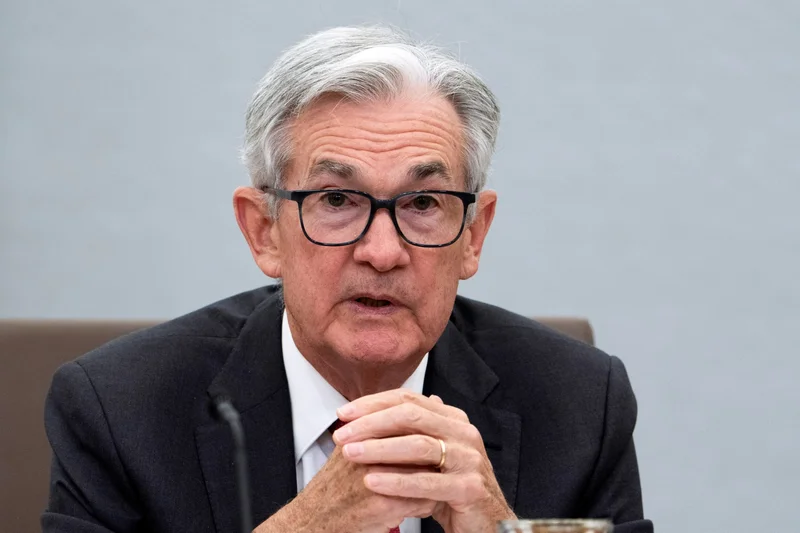
On October 9, 2025, Federal Reserve Chair Jerome Powell appeared at a Community Bank Conference. He wasn't there in person, of course—he was traveling. Instead, a pre-recorded video of his Welcoming remarks by Chair Powell at the Community Bank Conference played, showing a composed Powell calmly delivering platitudes about the vital role of community banks, their strong links to local businesses, and the Fed’s commitment to tailoring supervision. It was the kind of sterile, reassuring message you’d expect from the world's most powerful central banker. Standard procedure.
Except on that very same day, the institution Powell leads was facing a crisis that made his boilerplate remarks feel like a transmission from another planet. While the video played, the American economy was caught in a vicious crosscurrent of persistent inflation, a weakening labor market, and unprecedented political interference from a second-term Trump administration. The Fed, far from being a steady hand on the tiller, was being publicly and privately battered, forced to navigate a storm with a broken compass and a captain whose authority was being systematically dismantled.
The dissonance between Powell’s pre-recorded ghost and the chaotic reality is the entire story. It reveals a Federal Reserve trapped in an impossible situation, armed with economic tools designed for a world that no longer exists.
The Unraveling of the Soft Landing
Let’s rewind the tape. By the end of last year, the Fed was on the verge of a historic victory. After hiking rates at the most aggressive pace since the 1980s to combat the post-pandemic inflation surge, the data was finally breaking their way. The Personal Consumption Expenditures (PCE) price index, the Fed's preferred inflation gauge, had cooled to a four-year low of 2.3% by April 2025. The elusive "soft landing"—taming inflation without triggering a recession—was not just a possibility; it was the base case.
Then, the political variable changed. The Trump administration’s erratic trade war and policies like mass deportations were not standard economic inputs; they were geopolitical shocks injected directly into the system. Tariffs roiled supply chains and pushed up prices, while business uncertainty put a freeze on hiring. The Fed's carefully calibrated model was suddenly dealing with inputs it was never designed to handle. How does a central bank quantify political chaos in its forecasts? What is the correct monetary response to a trade policy that changes via a post on social media?
The result is a central bank working at cross-purposes with itself. Last month, the Fed cut rates by a quarter point. The justification was a softening labor market, with unemployment ticking up to 4.3% and job growth turning tepid. Yet this move came while their other mandate, price stability, remained unfulfilled. Cleveland Fed President Beth Hammack pointed this out with clinical precision on September 29th, noting, "We have been missing our mandate on the inflation side... for more than four and a half years."
The Fed is now easing monetary policy to support employment while simultaneously needing to maintain a restrictive stance to fight inflation. This isn't a "tug of war," as one analyst put it. It's more like a machine being ordered to accelerate and brake at the same time. The gears are beginning to grind.
Flying Blind in a Political Hurricane
I've analyzed hundreds of quarterly reports and central bank statements, and the current level of political interference is not just an outlier; it's a fundamental break from modern precedent. The Federal Reserve's efficacy is built on a foundation of political independence. That foundation is crumbling.
The current administration has not just criticized the Fed; it has actively sought to co-opt it. President Trump has publicly pressured for rate cuts, attempted to oust a sitting governor (Lisa Cook), and installed an economic adviser on the Fed's Board. He has also signaled his intent to name a new Fed chair this year, well before Powell's term expires in May. This is a deliberate tactic to dilute Powell's authority by creating a "shadow" leader, turning internal policy debates into political auditions. We're already seeing the effect: a clear split on the rate-setting committee, with Trump appointees advocating for the very rate cuts the President demands.
This political assault is happening at the worst possible moment. A looming government shutdown threatens to suspend the release of official economic data. The September jobs report is already delayed. Key inflation data is next. The Fed is being asked to land a 747 in a hurricane, but the instrument panel is going dark, and a faction of the passengers is trying to storm the cockpit.
This is the context for the bifurcation we see in the real economy. Corporate executives at Walmart and Target speak of low-income consumers whose balances are below pre-pandemic levels. Credit scores are falling at the fastest rate since the Great Recession. Cumulative price hikes since January 2021 are about 20%—to be more precise, the sustained increase in the PCE index represents a structural shock to the balance sheets of households without significant asset holdings. The Fed is being pressured to cut rates to ease this pain, but doing so risks embedding the very inflation that caused it. There are, as Powell himself admitted, "no risk-free paths now."
The Fed's Mandate Is Now an Impossible Equation
The dual mandate of maximum employment and price stability was conceived for an economy governed by cyclical business forces. It was not designed to counteract a political actor actively introducing volatility into the system. The Fed’s tools—interest rates and balance sheet adjustments—are blunt instruments meant to influence aggregate demand. They cannot fix a supply chain broken by tariffs. They cannot solve a labor shortage caused by deportations. They cannot create business confidence paralyzed by political uncertainty.
The Federal Reserve is being tasked with solving a political problem using an economic toolkit. It is an impossible equation. Every potential action creates an unacceptable reaction. Cut rates to help the weakening labor market, and you risk re-igniting inflation. Hold rates steady to fight inflation, and you risk tipping a fragile economy into recession. The institution is caught in a trap, and its credibility, its most valuable asset, is being drained with every politically-forced compromise. The calm, pre-recorded man on the screen isn't the real Jerome Powell. The real Jerome Powell is the one navigating a crisis for which there is no playbook.
Tags: jerome powell