

An airline press release is a carefully constructed piece of corporate communication. It’s designed to project confidence, growth, and strategic foresight. United Adds Flights to New Cities in Croatia, Italy, Scotland and Spain next Summer is a textbook example, boasting of being the “largest carrier across the Atlantic” and highlighting service to four new European cities.
On the surface, it’s standard industry fare. But when you look past the corporate boilerplate and start connecting the dots, a far more interesting strategy emerges. United isn't just adding destinations; it’s placing highly specific, data-driven bets on overlooked markets. The airline is moving like a quantitative hedge fund, seeking alpha in places its competitors have written off as rounding errors. And the key to understanding this playbook lies not in Paris or Rome, but on the Dalmatian coast of Croatia.
Deconstructing the Monopoly Play
Let’s first dispense with the obvious. Adding more flights to Tel Aviv or a new route to Seoul from Newark makes perfect sense. These are robust, high-demand markets. The new Washington-Dulles to Reykjavik flight builds on an existing, popular tourism trend. These are logical, incremental moves. The real story, however, is buried in the fine print: the new nonstop services from Newark to Split, Croatia; Bari, Italy; Glasgow, Scotland; and Santiago de Compostela, Spain.
Notice the recurring phrase in the announcement: “only airline.” United will be the only U.S. carrier with nonstops to these four cities. This isn't a head-to-head battle for market share against Delta or American on a trunk route to London. This is a series of calculated monopoly plays. United is planting its flag on routes where it will face zero direct competition from its U.S. peers, allowing it to control both capacity and pricing.
This strategy is akin to a value investor searching for undervalued assets, not chasing high-flying tech stocks. Instead of fighting for a few extra percentage points of market share on a hyper-competitive route like New York to Paris (a market with immense capacity), United is targeting 100% share of smaller, but potentially high-margin, niche markets. The aircraft choices reflect this. A Boeing 767-300ER (a widebody jet indicating significant demand projection) is slated for Split and Bari, while the smaller, more efficient 737-MAX8 will serve Glasgow and Santiago de Compostela. This isn't a one-size-fits-all expansion; it's a meticulously calibrated deployment of assets tailored to specific demand forecasts.
I’ve analyzed dozens of these network expansions, and what’s striking here is the complete absence of a direct competitive response. United isn't fighting for a bigger slice of the pie; they're baking entirely new, smaller pies for themselves. But this begs the question: how can they be so confident these pies are worth baking at all?
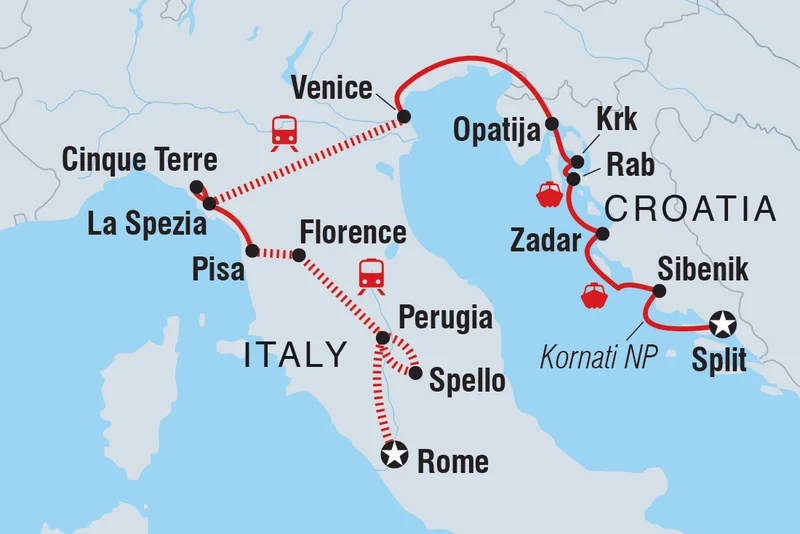
The Croatian Case Study
The selection of Split, Croatia, is the most telling data point in the entire announcement. While Dubrovnik has been on the tourist radar for years, Split has remained a secondary destination for the U.S. market. So why plant a flag there now, and with a fairly large aircraft? The answer likely lies in data that goes far beyond traditional passenger booking trends.
Consider two seemingly unrelated news items from Croatia in October 2025. First, archaeologists unearthed a massive 1500-year-old olive oil production complex discovered in Croatia near Split, a discovery hailed as one of the most significant in the region's economic history. Second, Pope Leo XIV addressed a crowd of some 10,000 Croatian pilgrims in St. Peter's Square, highlighting the country's deep and vibrant religious tradition.
To a legacy airline planner, these are cultural footnotes. To a data scientist building a predictive model, they are powerful, non-obvious indicators of future travel demand.
The archaeological find isn’t just about old stones; it signals the emergence of a new, high-value historical tourism circuit. It suggests a destination maturing beyond just beaches and nightlife, appealing to a wealthier, more educated demographic. This is the kind of traveler who doesn't just book the cheapest flight; they value the convenience of a nonstop connection and are willing to pay a premium for it. The papal address, meanwhile, quantifies the strength of religious and diaspora travel—a resilient and often non-discretionary travel segment. It’s no coincidence that another new destination is Santiago de Compostela, the endpoint of one of the world's most famous Christian pilgrimages.
United's model appears to be correlating these cultural data streams with search query trends, social media sentiment, and economic indicators to identify markets on the cusp of a demand inflection point. They see the smoke of rising cultural capital and are betting they can get there before their competitors even see the fire. The growth in passengers to Italy, Spain, and Portugal was about 11% last year—to be more exact, it was a record 1.5 million passengers as of August 2025. United is clearly looking for the next Portugal.
What is the precise weighting of these alternative data sets in their network planning model? And how do they quantify the risk of a destination failing to launch as a mainstream trend? These are the billion-dollar questions that United’s competitors are probably scrambling to answer right now.
This Isn't Tourism, It's Arbitrage
Let's call this strategy what it is. This is not a simple route expansion; it's a form of market arbitrage. United is exploiting the information gap between the perceived value of these secondary markets and their actual, data-indicated potential. By establishing itself as the sole nonstop U.S. provider, it creates a temporary monopoly, capturing premium fares from early adopters and establishing a foothold before the market becomes saturated. It’s a brilliant, capital-efficient way to grow internationally without getting drawn into a costly price war over the same handful of global megacities. The rest of the industry is playing checkers; United is playing a quiet, calculated game of Go.
Tags: croatia