

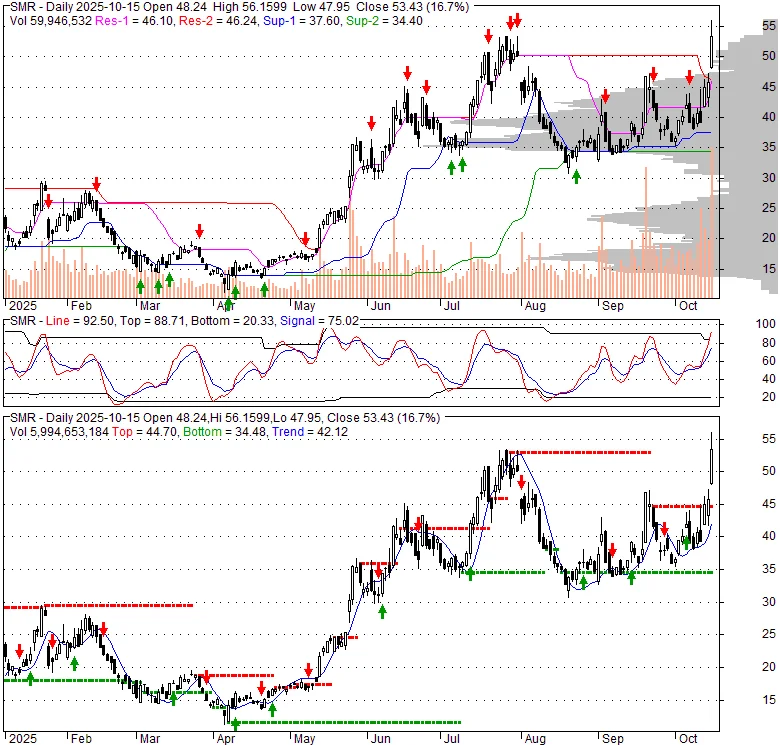
NuScale’s stock has become a fascinating case study in narrative versus numbers. In mid-October 2025, the company’s shares (NYSE: SMR) are trading around $45, a staggering ascent from a $10 IPO price back in May 2022. The recent catalysts are undeniably potent: a landmark 6-gigawatt deployment program with the Tennessee Valley Authority (TVA) and, more recently, speculative fever tied to a new U.S. Army initiative to power military bases with small reactors.
The market has clearly bought into the story, which helps answer the question of Why Is NuScale Power Stock Blasting Higher? A 14% intraday jump on the TVA news, followed by another surge on the Army announcement, shows an appetite for a future powered by clean, reliable nuclear energy. NuScale, with the first and only small modular reactor (SMR) design approved by the U.S. Nuclear Regulatory Commission (NRC), is positioned as the unambiguous front-runner. The narrative is clean, compelling, and perfectly timed for a world grappling with the voracious energy demands of AI data centers. But when you move past the headlines and into the cold, hard data, a very different picture begins to emerge.
The Anatomy of the Bull Case
The story propelling NuScale’s $13 billion valuation is built on a few powerful pillars. First, there's the regulatory moat. Securing NRC design approval in May 2025 for its uprated 77 MWe module was, as CEO John Hopkins put it, a "historic moment." In a field crowded with concepts, NuScale has the only certified product in the United States. This is a tangible, defensible advantage. You can't just spin up a nuclear reactor company in a garage; regulatory approval is the price of admission, and NuScale is the only one through the gate.
Then comes the commercial validation. The September 2025 agreement with the TVA, via NuScale’s partner ENTRA1, is the kind of deal that defines a company. Pitched as the "largest SMR deployment in U.S. history," the 6 GW program is designed to power the equivalent of 4.5 million homes or dozens of new data centers. This isn't a pilot program; it's a utility-scale commitment that seems to underwrite the entire SMR thesis. Add in other deals, like Standard Power’s plan for ~2 GW to power data farms in Ohio and Pennsylvania, and the demand side of the equation looks locked in.
This entire narrative is supercharged by the AI revolution. Tech leaders like Google’s CFO Ruth Porat are on record stating that nuclear simply "has to be a part of the mix." The logic is simple: AI requires immense, 24/7 power, and renewables can’t provide that baseload reliability. SMRs are presented as the perfect solution—carbon-free, scalable, and safe. The recent Army "Janus Program" announcement just adds another layer of speculative fuel, suggesting a future where NuScale reactors power critical national security infrastructure. It’s a powerful, almost irresistible, story.
A Discrepancy in the Data
And this is the part of the analysis that I find most telling. I’ve reviewed countless SEC filings and market reports, and when a company’s narrative diverges this sharply from its financial metrics and insider behavior, it warrants extreme scrutiny. The story is flawless. The numbers are not.
Let’s start with valuation. NuScale is currently trading at a trailing twelve-month Price-to-Sales ratio of 93.7x. For context, its competitor GE Vernova, which is also developing an SMR, trades at 4.37x sales, a valuation gap central to the question of NuScale Power vs. GE Vernova: Which Nuclear Energy Stock Has an Edge? NuScale isn’t just expensive; it’s priced at a level that assumes decades of flawless execution and market dominance. This is the kind of valuation you might see on a high-margin software company, not a pre-profit industrial firm expected to break even around 2030. What is the market pricing in here that justifies a 20-fold premium over a direct competitor?
Then there's the execution risk. The bull case hinges on NuScale building and deploying its reactors on time and on budget. Yet, the company’s own history provides a cautionary tale. In 2023, NuScale canceled its flagship demonstration project in Idaho after projected costs nearly doubled. While the company frames its factory-built model as a way to keep costs "low, consistent and predictable," the real-world data from its most recent major project attempt suggests otherwise. Investing in NuScale today is like buying a ticket for a rocket ship that has its blueprints approved and its mission celebrated in the press, but whose last launch simulation was scrubbed for technical issues. The stock price, however, is already in orbit.
Perhaps most damning is the insider activity. Just as the market was celebrating the TVA deal and pushing the stock to new highs, the "smart money" was quietly heading for the exits. In early October 2025, Fluor Corp, NuScale’s majority owner and the entity with the deepest possible insight into its operations, sold 15 million shares (netting a cool $605 million). This followed a September sale by a Fluor director who liquidated nearly 20% of their stake for $104 million. When insiders who presumably believe in the long-term story are cashing out at these levels, it sends a powerful signal. It suggests they believe the current stock price reflects a level of optimism that may not be matched by near-term reality.
Finally, there are the Wall Street analysts, the very people paid to model these future cash flows. Their consensus rating is a lukewarm "Hold," with a median price target hovering around $37-$40. It is a rare and telling situation when a stock is trading significantly above the average analyst target. It suggests the current price is being driven more by retail momentum and narrative than by fundamental financial modeling.
The Price of a Story
NuScale Power is not a fraud or a failure. It is a legitimate technology leader with a crucial regulatory advantage in a growing market. The problem isn’t the company; it’s the price. The current ~$45 stock price has baked in the successful, profitable deployment of the TVA project, future data center contracts, and perhaps even a piece of the Army’s new program. It leaves absolutely no margin for error—no room for project delays, cost overruns, or a competitor catching up. The market is paying today for a perfect version of 2030. Based on the valuation multiples, the insider selling, and the company's own project history, the risk is now heavily skewed to the downside. The story is compelling, but the numbers are telling a different one. And in the long run, the numbers always win.
Tags: smr stock