So you got an email from the government saying your student loans might finally be wiped away. Don't pop the champagne just yet. In fact, maybe put it back in the fridge. Behind the expired milk.
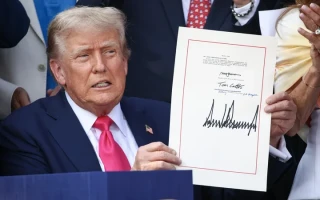
After a quarter-century of dutifully making payments—payments that probably added up to way more than you ever borrowed—the Trump administration has decided to start honoring a promise made back when most of us were still using dial-up. Some borrowers on Income-Based Repayment (IBR) plans are getting notices that their debt sentence is finally over.
My first thought? It’s probably a phishing scam. My second thought was, offcourse, that the reality is somehow worse.
This isn't a gift. It's not some benevolent act from on high. This is the government finally, grudgingly, paying a bill that’s been past due for years. These IBR plans were sold to us as a safety net: keep paying a percentage of your income for 20 or 25 years, and we’ll forgive the rest. It was a deal. Now, after dragging their feet, pausing processing, and generally making life hell for borrowers, the Department of Education is sending out a few emails and expecting a ticker-tape parade. Give me a break.
A Promise Wrapped in Red Tape
Let's be real about what this "forgiveness" actually is. It’s the finish line of a marathon nobody should have had to run in the first place. The IBR program itself is a bureaucratic labyrinth. The original version from 2009 demanded 15% of your discretionary income for 25 years. A newer, "nicer" version from 2014 dropped it to 10% for 20 years. It’s a system so confusing it feels designed to make you mess up.
And now, after all that, you get an email. A cold, sterile email that says, "Your loan servicer will notify you if and when your IBR discharge has been processed." Read that again. "If and when." That’s not the language of certainty. That’s the language of a cable guy giving you an eight-hour service window. The email says most will be processed in two weeks, but "for some borrowers, processing could take more time."
Who are these "some borrowers"? Is there a secret lottery? Do they throw darts at a list of names? This is the kind of vague, non-committal language that lets a bureaucracy off the hook when—not if—things go wrong. It’s like a magic trick where the magician promises to pull a rabbit out of a hat but first needs to fill out a mountain of paperwork, get three levels of approval, and then discovers the rabbit has been furloughed.
The whole thing feels less like a celebration and more like being released from a hostage situation. You're free, but you're blinking in the sunlight, disoriented, and wondering if it's all just a dream before they drag you back inside. What happens if there's a typo on your application from 17 years ago? What if a payment you made in 2011 was counted incorrectly? The system has zero margin for human error, and we're supposed to just trust that it will all work out now?

The Government Shutdown Is the Punchline
And just when you think this couldn't get more absurd, here comes the punchline: the government is shut down.
Yes, you read that right. The very same federal machine that’s supposed to be processing your long-awaited freedom has ground to a halt. The Department of Education has furloughed staff. A notice on the Federal Student Aid website basically says, "We're closed. Good luck." They even have the nerve to add, "borrowers should continue to make payments on your federal student loans as scheduled." It’s a masterclass in tone-deafness.
So you have this golden ticket, this email promising liberation, but the people who are supposed to honor it are at home watching daytime TV. The timing is so perfectly awful it almost feels intentional. This is a bad situation. No, "bad" doesn't cover it—this is a five-alarm dumpster fire of bureaucratic incompetence. It’s a system tripping over its own feet on the way to do the bare minimum. They promise you relief, but the people who are supposed to sign the papers aren't even at their desks, and honestly...
This delay isn't just an inconvenience; it could be a financial disaster. There’s a provision in the American Rescue Plan that makes student loan forgiveness tax-free, but only through 2025. If these shutdown-related delays push your forgiveness date into 2026, guess what? That "forgiven" debt could be treated as taxable income. Congratulations on your $80,000 of forgiven loans! Now you owe the IRS $20,000.
It’s a trap door hidden under the welcome mat. The only reason this isn't a complete catastrophe for everyone is because the American Federation of Teachers sued the government, forcing them to agree that the effective date of the relief will be when the borrower first became eligible, not when some paper-pusher finally gets around to it. But think about that. They had to be threatened with legal action to do the one thing that was obviously fair and logical. That’s the system we’re dealing with.
Don't Count Your Chickens
So, what's the real story here? Don't let the headlines fool you. This isn't a sudden burst of generosity. It’s a contractual obligation being met at a glacial pace, hampered by political gridlock, and booby-trapped with potential tax nightmares. It’s the government doing what it was supposed to do all along, but only after years of delays and only for the lucky few who navigated the maze perfectly for two decades.
For every person who gets this email, how many more are still lost in the system, have been given bad information by their servicer, or are just a few payments short because of some technicality? The details can be confusing, as explained in reports like New student-loan forgiveness under Trump is coming. Here's what borrowers should know.
This isn't a solution. It's a single drop of water in a desert of debt. And if you're one of the people who got that email, I am genuinely happy for you. But don't celebrate until the balance on your account actually says zero. Until then, it's just another promise from an institution that has a terrible track record of keeping them.
Tags: student loan forgiveness