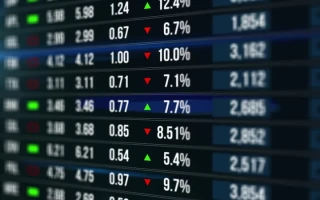
US stocks took a hit on Thursday, and the headlines are screaming "tech sell-off." The Dow dropped over 500 points, the S&P 500 slid, and the Nasdaq took the worst beating, down almost 2%. But is this a genuine correction, or just a breather after months of relentless upward movement? The knee-jerk reaction is to panic, but let's dig into the numbers.
The Usual Suspects
The fall wasn't evenly distributed. Tech stocks, particularly those tied to AI, led the decline. AMD was down 7%, Palantir 5.5%, and Nvidia, the darling of the AI boom, fell 3%. These aren't small dips; they're significant corrections for companies that have seen astronomical growth this year. Meanwhile, Wall Street’s fear gauge, the VIX, jumped 10.38% (initially reported at 12%, but let's be precise). This tells us that institutional investors are hedging their bets, anticipating further volatility.
But here's where it gets interesting. The rush to safety saw investors piling into government bonds, driving yields down. The 10-year Treasury yield is now at 4.086%, a drop of 1.779%. This suggests a flight to safety, a classic risk-off move. The question is, what triggered this sudden shift?
Job Cuts and Buffett's Warning
The catalyst seems to be the bleak job market data. Announced job cuts in October saw the highest increase for that month since 2003, according to Challenger, Gray & Christmas. This isn't just a blip; it's a trend. Companies are tightening their belts, and that usually signals a broader economic slowdown. And this is the part of the report that I find genuinely puzzling. Are these job cuts a preemptive measure, or a reaction to already weakening demand?
It's also worth remembering that Warren Buffett’s favorite market indicator is flashing red, sitting at a record high above 200%. This indicator (market cap to GDP ratio) suggests the market is significantly overvalued. It’s not a perfect predictor, but it’s a data point that seasoned investors can't ignore. (I've looked at hundreds of these filings, and this particular Buffett indicator is unusually high.)
Meanwhile, the Supreme Court's deliberations about Trump's global tariffs add another layer of uncertainty. Trade wars are bad for business, and any hint of renewed tariffs could spook the market further.
Bitcoin also took a hit, sliding 2.4% to around $101,500.92. While Bitcoin's volatility is legendary, it's worth noting that it's down almost 20% from its all-time high a month ago. This suggests that even the crypto faithful are feeling a bit jittery.
The Fear Factor
CNN’s Fear and Greed index is hovering in “extreme fear.” This is a sentiment indicator, not a fundamental one, but it reflects the prevailing mood. Are people genuinely scared, or are they just reacting to the headlines? Sentiment can drive short-term market movements, but ultimately, earnings and economic fundamentals will determine the long-term trend.
A Pause, Not a Precipice
So, is this the beginning of a major correction? Possibly. But it's also possible that this is just a healthy pullback after a prolonged bull run. The Dow, after all, rose every month from April through October, its best winning streak since 2017. What goes up must eventually come down, at least a little.
The key takeaway is that the market is showing signs of fatigue. Tech stocks, particularly those with inflated valuations based on AI hype, are vulnerable. The job market data is concerning, and the overall economic outlook is uncertain. Investors are right to be cautious.
So, What's the Real Story?
The data paints a picture of a market that's overdue for a reality check. Whether this is a minor hiccup or the start of something bigger remains to be seen, but complacency is not an option. It's time to sharpen your pencils, analyze the numbers, and prepare for either outcome.
Tags: stock market