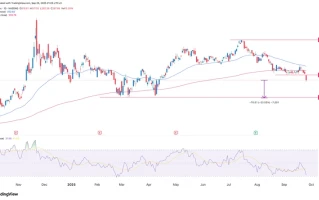
A 6.5% intraday surge in a stock as volatile as Strategy (MSTR) is hardly a statistical anomaly. The company’s shares have registered more than 70 moves greater than 5% over the last year, a clear reflection of their tight correlation to their underlying asset, Bitcoin. Yet the rally on Wednesday was different. It wasn’t driven by a sudden spike in the price of Bitcoin, though the digital asset did see a modest recovery. Instead, the catalyst was a dry, technical filing with the Securities and Exchange Commission.
The filing referenced an interim guidance note from the Department of the Treasury and the IRS. The subject was the Corporate Alternative Minimum Tax (CAMT), a 15% levy established by the 2022 Inflation Reduction Act targeting large corporations. Specifically, the guidance clarified that when calculating their Adjusted Financial Statement Income (AFSI) to see if they cross the $1 billion average annual threshold, companies can disregard unrealized gains and losses from digital assets.
For almost any other company, this would be a minor footnote. For Strategy, it was a tectonic event. The market’s initial reaction, a simple price jump, suggests a surface-level understanding: a tax liability has been avoided. My analysis suggests the implications are far more profound. This isn’t just a tax break; it’s a regulatory validation of Michael Saylor’s entire corporate re-engineering project.
To grasp the magnitude of this shift, one must understand the threat the CAMT posed. Under the new mark-to-market accounting rules adopted in January, Strategy must report changes in Bitcoin's value directly on its income statement. With holdings now exceeding 640,000 BTC, the numbers are staggering. The company reported an $8.1 billion unrealized gain on Bitcoin for the first half of 2024 alone. Its total reserves, acquired for an average price far below current levels, carry an unrealized gain of nearly 60%.
Under the previously proposed regulations (issued as recently as September 2024), these paper gains would have counted toward its AFSI. Strategy itself warned investors it expected to become subject to the 15% CAMT beginning in 2026. The potential tax liability was enormous. A 15% tax on just the H1 2024 gain would have represented a cash-outflow obligation of over $1.2 billion. For a company whose primary strategy is to acquire and hold, not sell, this presented a serious liquidity paradox: being forced to potentially sell the asset to pay the tax on the asset’s appreciation. The Treasury’s new guidance vaporized that paradox overnight.
Beyond the Bitcoin Bet: A New Structural Advantage
The Great Decoupling
This ruling does more than just save the company money. It fundamentally alters its valuation calculus and cements its identity. For years, analysts have struggled with the dual nature of MSTR: is it a business intelligence software firm or a de facto Bitcoin fund? The software business provides cash flow, but the balance sheet, with roughly $74.6 billion in Bitcoin as of June 30, tells the real story. The stock doesn’t trade on software sales; it trades as a leveraged bet on Bitcoin. This tax clarification effectively blesses that reality.

By exempting the primary driver of its book value from the CAMT, the government has inadvertently created a uniquely tax-advantaged vehicle for institutional Bitcoin exposure. It allows the company to reflect massive appreciation on its financial statements—a key requirement for index inclusion—without triggering a crippling tax event. I've looked at hundreds of these filings, and it's rare to see a single piece of regulatory guidance so perfectly tailored to the unique, and frankly bizarre, balance sheet of one specific company. It removes the single largest structural impediment to Strategy’s long-term hold strategy.
The market’s reaction, while positive, seems to be lagging behind these second-order effects. The chatter on platforms like Stocktwits, a useful if imperfect gauge of retail sentiment, trended into ‘bullish’ territory on ‘high’ volume. This indicates excitement, but the core conversations still revolve around the direct link between MSTR and the price of Bitcoin, which was trading around $117,000 at the time. The more critical development is the potential for a structural decoupling of MSTR’s valuation from a simple multiple of its Bitcoin holdings.
The most immediate consequence, noted by Bloomberg analyst James Seyffart, is the now-clear path to S&P 500 eligibility. The index requires, among other things, four consecutive quarters of positive reported earnings. With the mark-to-market gains now flowing to the bottom line and the corresponding tax liability neutralized, Strategy is on track to meet this requirement. Analysts are already projecting a net income of about $2.9 billion for the third quarter—to be more exact, $2.9 billion with earnings of $10 per share.
S&P 500 inclusion would be a game-changer. It would force buying from the trillions of dollars in passive index funds that must track the index. This isn’t speculative demand; it’s mechanical, programmatic buying. The Treasury’s guidance didn’t just clear a tax hurdle; it may have paved a golden path into the world’s most important stock index, triggering a demand shock that has very little to do with the daily price of Bitcoin.
The question, then, is no longer how to value Strategy’s software business. The question is how to price this new, state-sanctioned structural advantage. Wall Street consensus remains a ‘Strong Buy’ with an average price target implying significant upside, but one has to question the models being used. Are they pricing in the probability of index inclusion? Are they adjusting for the removal of a multi-billion-dollar contingent liability? Or are they simply extrapolating the price of Bitcoin? My suspicion is it’s mostly the latter, which means the full impact of this obscure tax ruling has yet to be priced in.
A Regulatory Moat
This isn't just another chapter in the volatile story of a crypto-linked stock. It's a case study in corporate finance and regulatory navigation. Michael Saylor's primary thesis was that he could turn a software company into a vehicle for acquiring and holding Bitcoin more efficiently than other entities. With this Treasury guidance, the U.S. government has effectively, if unintentionally, handed his strategy its most significant validation to date, carving out a specific and powerful advantage for his uniquely structured enterprise. Strategy is no longer just a company that holds Bitcoin; it is now arguably the most tax-efficient corporate vehicle for doing so in the public markets. The numbers on the balance sheet were already compelling; the text in this new tax code clarification makes them formidable.
Reference article source:
- MSTR Stock Rallies After Strategy Says Bitcoin Gains Exempted From Corporate Minimum Tax
- This Is Why Strategy Stock (MSTR) Is Rallying Today
- Why Is MicroStrategy (MSTR) Stock Rocketing Higher Today
Tags: mstr stock