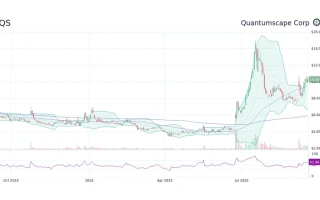
The recent price action in QuantumScape (NYSE:QS) presents a fascinating, almost textbook, case study in market dynamics. In the past month alone, the stock has appreciated by over 80%, with its year-to-date performance showing a gain of more than 200%. The shares recently touched a 52-week high of nearly $18—to be more exact, $17.77—before pulling back slightly (QuantumScape (QS) Stock Hits 52-Week Highs: What's Driving The Surge?). This is the kind of momentum that gets headlines.
But when we strip away the ticker tape and the trading chatter, we arrive at a stark, fundamental data point: QuantumScape currently generates zero dollars in revenue. This places its market capitalization, which hovers around $9 billion, in a category that requires careful examination. The valuation isn't based on earnings, sales, or cash flow. It is, instead, an equation built almost entirely on future potential, strategic alliances, and the market's collective bet on a technological breakthrough. The question isn't whether the stock is "good" or "bad." The question is, what exactly are investors pricing in?
Deconstructing the Catalysts
The surge isn't random noise. It's a direct market reaction to a series of specific announcements that, in theory, de-risk the company's path to commercialization. The primary drivers were two critical partnership agreements, one with manufacturing giant Corning and another with Murata Manufacturing (QuantumScape stock rises after Murata partnership for battery components By Investing.com). Both deals center on the same objective: developing and mass-producing the ceramic separators that form the core of QuantumScape’s solid-state battery technology.
This is the lynchpin of the entire enterprise. QuantumScape’s core innovation is its solid ceramic separator, which allows for the use of a pure lithium-metal anode. This design promises higher energy density, faster charging, and improved safety over conventional lithium-ion batteries. But the science, while promising in the lab, has always faced one monumental hurdle: manufacturing these delicate, defect-free ceramic separators cost-effectively and at an industrial scale.
Think of it this way: for years, QuantumScape has had a revolutionary recipe for a cake that could change the world. The problem was, they didn't have an oven capable of baking millions of them perfectly every single day. The partnerships with Corning and Murata are not about improving the recipe. They are about building the oven. By bringing in world-class experts in ceramics and high-volume manufacturing, QuantumScape is sending a clear signal to the market that it is shifting from a research-and-development phase to an industrialization phase.
This narrative was further amplified by a real-world demonstration at the IAA Mobility show, where Volkswagen’s subsidiary PowerCo showcased a Ducati motorcycle equipped with QuantumScape's QSE-5 battery cells. While a single motorcycle is a far cry from a fleet of EVs, it serves as a powerful qualitative data point. It moves the technology from a PowerPoint slide to a tangible, functioning product. It’s the proof of concept that validates the recipe, giving investors the confidence to bet on the construction of the oven.
A $9 Billion Bet on Execution
This brings us back to the valuation discrepancy. I've analyzed hundreds of pre-revenue tech and biotech firms, and a valuation of this magnitude typically hinges on a single, binary event—like an FDA approval for a new drug. For QuantumScape, there is no single event. Instead, its success depends on a series of grinding, complex, and uncertain manufacturing milestones.
The market is currently assigning a $9 billion value to a company whose own management stated in a recent earnings release: "The challenges of scaling production remain significant, and there is still much work left to do." This isn't a criticism; it's a statement of fact. The agreements with Corning and Murata are immensely positive steps, but they are statements of intent, not guarantees of output. The press releases express excitement and commitment, but they are conspicuously light on specifics. What are the precise volume targets? What are the timelines and capital commitments (beyond Volkswagen's recent investment, a reported $131 million expansion)? What are the penalties or exit clauses if milestones are missed?
This is where the analysis moves from the known to the unknown. The market's current enthusiasm is pricing in a very high probability of success on the manufacturing front. The Benzinga Edge Momentum score of 97.75 reflects this sentiment perfectly; it's a measure of market belief, not a measure of produced goods. The stock has broken through previous technical resistance levels, suggesting that traders are betting the forward-looking story will continue to outweigh the present lack of fundamentals.
The risk, therefore, has shifted. For years, the primary risk was technological: could the science actually work? The Volkswagen demo and continued partner support suggest the market is increasingly comfortable with that question. The new, multi-billion-dollar risk is entirely operational: can they actually build it? Can they do it at a cost that makes commercial sense and at a scale that can supply a global automotive industry? These are questions that won't be answered by another lab test, but only by the hum of a factory floor that, for now, remains largely conceptual.
The Bet Is on Manufacturing, Not Miracles
Let's be perfectly clear. The recent QuantumScape rally is not about a new scientific discovery. The market has moved past the question of whether the technology can work. The current $9 billion valuation is a pure, high-stakes wager on industrial execution. Investors are no longer betting on a miracle in the lab; they are betting on the successful, and historically difficult, scaling of a complex manufacturing process. The partnerships with Corning and Murata are simply tools to quantify and, hopefully, reduce the risk of that process failing. But the underlying reality remains: this is a pre-revenue company whose value is derived entirely from a future promise. The price on your screen today is not a reflection of what QuantumScape is, but a probabilistic calculation of what it might one day become.
Tags: qs stock