

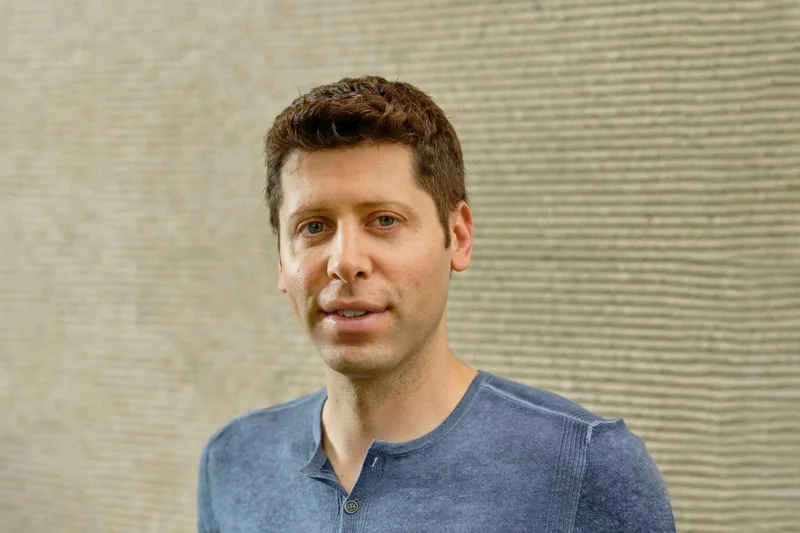
It seems like you can’t open a browser these days without being hit by a tidal wave of opinions about Sam Altman. One headline paints him as a Machiavellian villain, a digital thief kingpinning the heist of the century. The next portrays him as a reckless founder, moving too fast and breaking things that can’t be easily fixed. And I get it. The sheer velocity of what’s happening at OpenAI is enough to give anyone whiplash.
When you hear about a trillion dollars in dealmaking this year alone, or see the staggering leap from the first version of Sora to Sora 2 in under a year, it’s easy to get lost in the chaos. It’s easy to see the individual trees—the copyright disputes, the political maneuvering, the safety lawsuits—and miss the forest entirely.
But I want you to take a step back with me. I want you to look past the noise and see what I see. Because I don’t think Sam Altman is just building a company, and he’s certainly not just building a suite of cool apps. I believe we are witnessing the construction of a new foundational layer for human interaction with technology. A new kind of operating system for reality itself.
The Architecture of Ambition
Let’s talk about those deals for a second. The partnerships with chip firms like Nvidia and AMD, totaling over a trillion dollars, aren’t just big numbers meant to impress shareholders. This is about securing the fundamental resources for the next decade of innovation. He's securing compute power—in simpler terms, the raw horsepower needed to think at a planetary scale.
This isn’t like building a better search engine or a new social media app. This is like trying to invent the automobile and, in the process, deciding you need to own the steel mills, the rubber plantations, and the oil fields to make it happen. The products we’re seeing, like ChatGPT and the jaw-droppingly creative Sora, aren’t the end goal. They are merely the first, dazzling applications running on a platform that is still being built under our feet. When I first saw the demo videos for Sora 2, I honestly just sat back in my chair, speechless. This is the kind of breakthrough that reminds me why I got into this field in the first place—it’s a glimpse of a future where the only limit to creation is the scope of our imagination.
Think about it. ChatGPT is already becoming a new interface for information, a conversational layer over the static web. Sora is doing the same for visual creation. The new AI-powered workplace tools they’re testing internally signal a move into enterprise software. Each of these isn't a separate product line; it's a tentacle of a single, unified intelligence platform designed to integrate into every facet of our lives. This isn’t a series of disjointed announcements; as Box CEO Aaron Levie noted, it’s a strategic creation of a network effect across multiple industries at once.
Navigating the Paradigm Shift
Now, I know what the critics are saying. I’ve read the articles that call this a reckless race for revenue, a blatant disregard for rights and safety (It’s Sam Altman: the man who stole the rights from copyright. If he’s the future, can we go backwards? | Marina Hyde). They scream that OpenAI’s motto is “we’ll do what we want and you’ll let us.” And yes, there is real friction here. There are legitimate, thorny questions about copyright, safety, and the societal impact that we absolutely must address. The lawsuits from families who have suffered tragedy are heartbreaking, and they underscore the immense responsibility that comes with wielding this kind of power.
But to frame this purely as a story of a hero or a villain is to miss the historical pattern. What we’re seeing is a paradigm shift, and those are never clean. Imagine the invention of the printing press. It was a chaotic, disruptive force that put scribes out of work, created a crisis around the concept of authorship, and was seen by the establishment as a dangerous tool for spreading heresy. Yet, it ultimately democratized knowledge and laid the groundwork for the Renaissance and the Enlightenment.
We are living through a hyper-accelerated version of that moment, and the speed of this is just staggering—it means the gap between an idea and its execution, between a question and its answer, between imagination and reality is collapsing faster than we can even comprehend. This isn’t about moving fast to beat competitors. It’s about moving fast because the technology itself is evolving at an exponential rate. As Rubrik CEO Bipul Sinha put it, “AI is a phenomenon. It has a super exponential trajectory.” You either ride that wave, or you’re swept away by it.
The challenge for Altman, and for all of us, is to build the guardrails as we build the engine. It’s to infuse this new operating system with the values we want to carry into the future. Can we do it? Can we build a platform that amplifies human potential without amplifying our flaws? That’s the real question.
The Dawn of a New Platform
We’re so caught up in judging the architect that we’re failing to marvel at the cathedral being built. The endless debate over Sam Altman’s motives, his politics, or his personality is a distraction from the much larger story. We are at the very beginning of a new technological epoch, one where generative AI becomes a ubiquitous, foundational layer of our world, like electricity or the internet. The question isn't whether this is good or bad. It's here. The real question is: what will we, the users, the creators, the dreamers, build with it? This isn't just Sam Altman's future; he's just laying the groundwork for ours.
Tags: sam altman