

ASML is, without question, a structural monopoly. In the high-stakes world of semiconductor manufacturing, the Dutch giant is the sole supplier of the extreme ultraviolet (EUV) lithography machines required to etch the world's most advanced chips. Every sliver of silicon powering the AI revolution, from TSMC, Samsung, or Intel, has passed through an ASML system. This is not a competitive advantage; it’s a chokehold on the entire digital future.
The market understands this. After a sluggish start to 2024 where sales grew a mere 3% and earnings actually fell, the stock has roared back to life. The narrative is straightforward: the AI boom, particularly in the DRAM market, has reignited demand, and ASML is back on its explosive growth trajectory. The numbers, on the surface, seem to confirm this optimism. But looking at the data ahead of its October 15th earnings report, I see a significant discrepancy between the market's enthusiasm and the underlying risks embedded in the company's outlook. The current valuation seems to be pricing in a flawless future, a scenario that rarely materializes, even for a monopoly.
The Anatomy of a Rebound
To understand the current sentiment, one must look at the quarterly performance data. The turnaround has been nothing short of breathtaking. After posting a year-over-year net sales decline of 9.5% in the second quarter of 2024, the company’s growth accelerated dramatically. By the first quarter of 2025, sales growth hit 46.4%, with earnings per share rocketing up by an astonishing 93%—to be more exact, 92.9%.
This is the kind of V-shaped recovery that gets investors excited. The engine behind this surge is clear: the voracious appetite for AI hardware, which has pulled the memory chip market out of its slump and driven new orders. ASML’s management is forecasting full-year 2025 sales growth of 15% with gross margins expanding to around 52%. Analysts are even more bullish, projecting a compound annual growth rate of 16% for EPS through 2027.
But a recovery driven by a single, powerful tailwind should invite scrutiny. Is this surge the new normal, or is it a cyclical bullwhip effect from the AI buildout? Extrapolating this recent, supercharged growth rate into the future is a dangerous game. It assumes the demand for AI chips will continue its vertical climb without interruption and that no other macro factors will intervene. I've looked at hundreds of these cyclical turnarounds, and this particular one feels unusually dependent on a single market segment whose long-term demand curve is still a matter of intense debate. What happens when the current wave of GPU and memory upgrades crests?
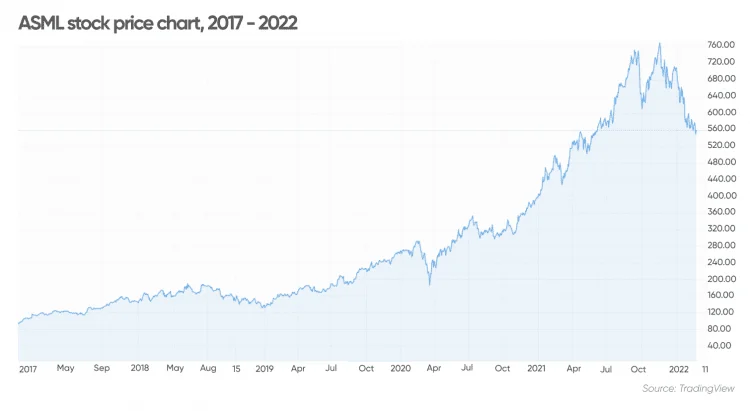
The company's position is unique, but it isn't immune to the laws of economic gravity. Treating a cyclical peak as a permanent plateau is a classic analytical error, and I see signs of it everywhere in the commentary surrounding this stock.
An Engine Running on Volatile Fuel
The primary issue is that ASML’s stock is now priced for perfection. At 34 times next year's earnings, its valuation leaves absolutely no room for error. The market is essentially betting that the company can navigate a minefield of geopolitical and operational challenges without a single misstep. This seems, to put it mildly, optimistic.
ASML's situation is like a Formula 1 car built with unparalleled technology, but it's being asked to race on a track littered with geopolitical oil slicks. The most significant of these is the escalating tech rivalry between the U.S. and China. ASML is already barred from selling its top-tier EUV systems to China, and restrictions on its less advanced DUV systems are tightening. With both Washington and Beijing implementing new export and import controls on everything from AI chips to rare earth metals, ASML is caught squarely in the middle. Any further escalation threatens a significant portion of its addressable market and could disrupt the global supply chain its other customers depend on.
And this is the part of the analysis that I find genuinely puzzling. Sell-side models seem to be treating these immense geopolitical risks as minor variables rather than core threats to the thesis. The projected revenue growth implicitly assumes a stable, predictable global trade environment—an assumption that is directly contradicted by daily headlines about how ASML looks to calm fears over 2026 growth as it warns of China sales decline.
Beyond geopolitics, there are internal pressures. The company is spending heavily to ramp up production of its next-generation "high-NA" EUV systems. These machines are technological marvels, but they are also incredibly complex and expensive to produce (the reported cost is over $350 million per unit). If demand softens even slightly just as this capital-intensive rollout hits its peak, the impact on margins could be severe. The company’s forecast for a 52% gross margin is healthy, but it relies on a perfect balance of booming sales and controlled costs. Can it truly deliver both in such an uncertain environment?
The Premium for Perfection
So, what's the verdict before the earnings call? My analysis suggests that buying ASML at its current price is less an investment in a dominant company and more a speculation on a perfect narrative. The market has already priced in the explosive AI-driven recovery, the successful rollout of high-NA systems, and a benign geopolitical climate. Any negative deviation from this script on October 15th—a slight downward revision in guidance, a mention of supply chain friction, or cautious commentary on China—could trigger a sharp correction. The potential upside from a strong report feels limited, as so much good news is already baked in. The downside risk, however, feels substantial. This isn't a bet on ASML's quality; it's a bet on its ability to walk on water. And in my experience, that's a bet that rarely pays off.
Tags: asml stock