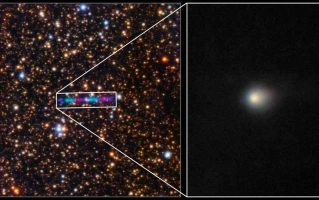
A Cosmic Visitor Meets a Terrestrial Shutdown: The Data Risk of 3I/ATLAS
An object designated 3I/ATLAS is currently moving through our solar system at approximately 210,000 kilometers per hour (a speed of roughly 137,000 mph). As only the third confirmed interstellar visitor, its value as a scientific asset is, for all practical purposes, infinite. It’s a pristine sample from another star system, carrying data that could rewrite our understanding of planetary formation. Yet, as this priceless asset makes its closest approach, the primary agency tasked with analyzing it has effectively been sent home.
The numbers are stark. A federal government shutdown has furloughed 83% of NASA’s workforce—to be more exact, over 15,000 employees. This operational paralysis coincides with one of the most critical observation windows for `3i/atlas`, a period in early October just before the comet slips behind the sun, temporarily blinding our Earth-based telescopes. While automated spacecraft remain operational, the situation on the ground presents a significant, and entirely self-inflicted, data risk. The core question isn't whether the comet is a threat to us, but whether our own institutional dysfunction is a threat to the science.
The Asset: A Priceless Interstellar Sample
Let’s be clear about what we’re observing. 3I/ATLAS is not a doomsday rock or an alien messenger; it’s a dirty, carbon-rich snowball that poses zero threat. Orbital mechanics are unforgiving, and its trajectory will miss Earth by a comfortable 270 million kilometers. Instead, its value lies in its composition. This is a physical object that formed in a completely different protoplanetary disk, a place with its own unique chemistry and history.
Initial spectroscopy from the Webb and SPHEREx missions provides a fascinating top-line summary. The comet is venting enormous amounts of carbon dioxide and water ice, with a CO₂/H₂O ratio of about 8:1. This is an outlier compared to most comets from our own system. The relative lack of carbon monoxide suggests it was formed in a carbon-heavy environment and may be exceptionally old, possibly over seven billion years—predating our own Sun. Is 3I/ATLAS an Interstellar Messenger? New Findings Debunk Alien Rumors but Reveal an Ancient, Carbon‑Rich Comet
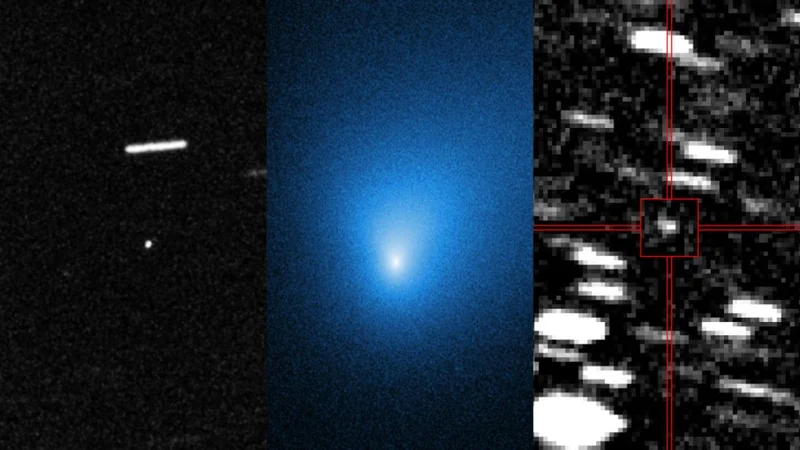
Think of `3i/atlas` as a sealed vial containing a sample of the primordial gas from another star’s nursery. We have a brief window to analyze its contents as solar radiation heats the vial and releases its secrets. We can see the `interstellar comet 3i atlas tail` and its teardrop-shaped coma, but the most valuable data is in the light spectrum—the chemical fingerprint of a world we’ll never see. You don't get a second chance to run this experiment. The sample is transient. To compromise the observation campaign is to risk losing the data forever. So why would we choose to do that now?
The Operational Failure: A Self-Inflicted Blind Spot
The timing of this institutional failure is almost perfectly misaligned with the celestial opportunity. The early October Mars fly-by, when the comet passed within 29 million kilometers of the planet, was a key data-gathering event. ESA’s Mars Express and Trace Gas Orbiter were positioned to collect spectra, while NASA’s own rovers and orbiters were tasked with support observations. After this, ESA’s JUICE mission is scheduled to watch the comet brighten in November. This is a complex, multi-agency, multi-instrument campaign. And its lead coordinator just had most of its expert staff locked out of their offices.
I've analyzed operational risks in high-stakes environments before, and this scenario is a classic case of unforced error. While the spacecraft themselves are largely autonomous, the human element is what turns raw telemetry into scientific insight. Who is calibrating instruments in response to unexpected flare-ups from the comet's nucleus? Who is managing the terabytes of data flowing in from Mars to ensure it isn’t corrupted or misfiled? Who is on the call with European counterparts to adjust observation schedules based on real-time findings?
Leaving a skeleton crew to "keep the lights on" is not a substitute for a fully engaged scientific team. It’s like asking a security guard to oversee a multi-billion-dollar merger. The core functions may continue, but the strategic, analytical, and adaptive work grinds to a halt. What is the margin of error for a mission like this? How many anomalies in the data stream will be missed by a depleted team, only to be discovered months later when it’s too late to follow up? These are the questions that should be keeping mission planners awake at night.
The public narrative focuses on the hardware—the orbiters and telescopes that are still pointing in the right direction. But the most critical component in any data-analysis pipeline is the trained human mind. By furloughing its experts, NASA has voluntarily degraded its own processing power at the moment of peak demand.
Quantifying the Noise: Speculation as a Market Indicator
Into this information vacuum steps predictable noise. We see Harvard’s Avi Loeb, an academic known for his contrarian theses, warning the U.N. of a "Black Swan Event." Shutdown Forces NASA Furloughs While Avi Loeb Warns U.N. of Black Swan Risk As 3I/ATLAS Nears Perihelion. We see social media platforms flooded with debunked claims about alien spacecraft and doctored quotes from physicists. From a data analyst's perspective, this isn't a story about aliens. It's a textbook example of how speculation fills a void left by institutional silence.
The market—whether for stocks or for information—abhors a vacuum. When the most credible source of analysis goes quiet, the signal-to-noise ratio collapses. Outlier theories, like Loeb’s suggestion of a non-random encounter, gain disproportionate attention because the institutional voices that would normally contextualize or rebut them are sidelined. The public fascination isn't the problem; it's a rational response to an extraordinary event. The problem is the absence of a clear, authoritative, and continuous stream of data-driven analysis from the agency best equipped to provide it.
The viral rumors are merely a qualitative indicator of the underlying operational deficiency. They are the market's way of pricing in the uncertainty created by NASA's shutdown. The less official data we get, the more speculative the information landscape becomes.
An Avoidable Data Deficit
The real story of 3I/ATLAS has nothing to do with aliens or collisions. It's a story about a catastrophic failure of risk management. We have been given a priceless, fleeting opportunity to capture a dataset from outside our solar system, and we have responded by intentionally hobbling our analytical capabilities. The spacecraft will continue to collect photons, but data without timely, expert analysis is just unrealized value. The observations lost and the connections missed during this shutdown represent a permanent deficit in our collective knowledge. The comet will fly by only once. The data we fail to properly capture is gone for good.