

Starship's Flight 11: The Data Suggests a Shift from Spectacle to Schedule
The first data point from Starship’s 11th test flight wasn’t a telemetry reading or a chamber pressure metric. It was a visual anomaly. Just after sunset on October 13th, a luminous, ethereal "jellyfish" bloomed in the twilight sky over Florida, prompting thousands of people across the southeastern United States to ask, What was that? SpaceX Starship launch lights up the US skies. This wasn't a UFO; it was the exhaust plume from a 403-foot rocket launched from Texas, a rocket whose successful ascent was so powerful and reached such an altitude that its signature was visible hundreds of miles away.
This spectacle, while photogenic, is more than just social media fodder. It's a qualitative indicator of the program's new reality. For years, the story of Starship was one of ground-shaking explosions and "rapid unscheduled disassemblies." The public narrative, fairly or not, was defined by failure. But the data from the last two flights, culminating in this one, suggests a fundamental phase shift. The primary question is no longer if Starship can reach orbit. The question is now about reliability, cadence, and the economics of reusability. SpaceX has moved from pure R&D into the far less glamorous, but infinitely more important, phase of operational refinement.
The early tests, with their fireballs and flying debris, were never failures in the traditional aerospace sense. My analysis suggests they were something else entirely: an aggressive, and frankly brutal, form of data acquisition. Think of it less like building a skyscraper and more like agile software development applied to a city block of stainless steel. Each explosive test was the hardware equivalent of a critical bug report, generating terabytes of information on what needed to be fixed for the next build. This approach is anathema to the old guard of aerospace, which prioritizes flawless execution on the first try. SpaceX prioritizes speed of iteration.
Gwynne Shotwell, SpaceX's President, acknowledged this inherent risk before the flight, stating, "you never know when you're going to get punched in the face." This isn't just corporate boilerplate; it’s a concise summary of their risk model. But after a string of such punches, Flight 11 demonstrates a system that has learned to duck. It successfully repeated the milestones of its predecessor—a clean launch, hot-staging, and a controlled descent of the Super Heavy booster into the Gulf of Mexico. The era of spectacular failure appears to be over. The era of boring, repeatable success may have just begun.
Quantifying the Iteration
Let’s move past the visuals and look at the numbers. The manifest for Flight 11 contained several key data points that signal a maturing program. For the second time, the mission used a "flight-proven" Super Heavy booster. Furthermore, 24 of its 33 Raptor engines had flown before. This isn't just about recycling; it's the entire economic thesis of Starship in action. Without rapid and cheap reusability, the vehicle is just another super-heavy-lift rocket—an impressive but economically dubious achievement.
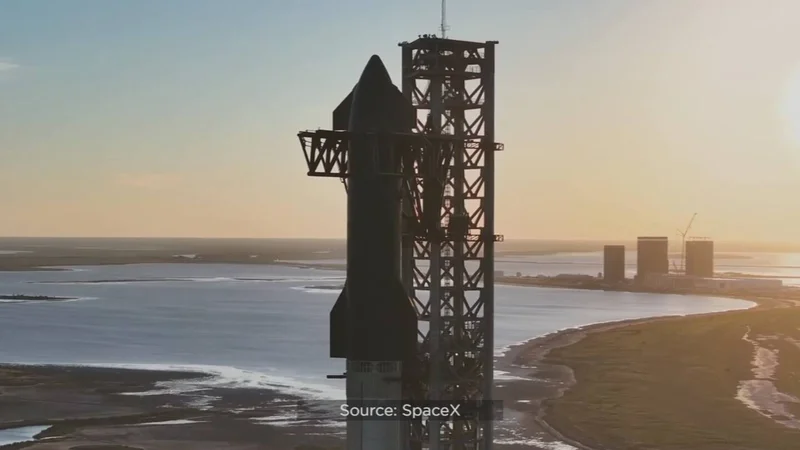
The real progress, however, is in the subtler objectives. SpaceX detailed plans to stress-test the upper stage's heat shield and attempt mid-flight maneuvers critical for an eventual return to the launch site. The booster's planned splashdown in the Gulf of America (a recent, and somewhat peculiar, government renaming of the Gulf of Mexico) and the ship's intended landing in the Indian Ocean are deliberate steps. They are pushing the performance envelope just enough to gather data for the next, more ambitious goal: catching the booster with the launch tower's "chopsticks." I've looked at hundreds of corporate development roadmaps, and the velocity of this program—from barely clearing the pad to executing complex atmospheric re-entry profiles—is a genuine outlier.
This progress is impressive, but it also highlights where the publicly available data runs thin. We know they are reusing components, but what is the actual refurbishment cost and turnaround time? How many flights can a Raptor engine realistically endure before requiring a complete overhaul? These are the variables that will determine whether Starship becomes a revolutionary transport system or the most expensive artificial reef program in history. Without that data, any long-term valuation of the program remains speculative. Is SpaceX on a path to a sub-$10 million launch cost, or will the operational overhead prove to be a hidden anchor on the balance sheet?
The NASA Checkbook Looms
While Elon Musk’s long-term vision is fixed on Mars, the program's immediate future is tied to a more terrestrial client: NASA. The American taxpayer, via the Artemis program, is a critical stakeholder. NASA’s plan to return astronauts to the moon hinges entirely on a modified version of Starship, the Human Landing System (HLS), to ferry crew from lunar orbit to the surface. The current target for that mission, Artemis III, is 2027. That deadline is no longer a distant sci-fi concept; it's a looming project milestone.
Every successful test flight like this one de-risks NASA's bet on SpaceX. The agency took a calculated gamble, choosing a radical, unproven design over more conventional (and likely more expensive) proposals. The early explosions must have caused considerable anxiety in Washington D.C. A flight like this one, where the vehicle performed almost exactly as planned for its hour-long mission—to be more exact, its planned suborbital trajectory was set for about 65 minutes—allows NASA officials to breathe a little easier.
The pressure is now shifting. The technical risk is being incrementally retired with each flight. Now, the schedule risk comes into focus. Can SpaceX go from successful ocean landings to crew-rated, pinpoint landings on the moon in less than three years? Can they build and launch the multiple tanker flights required to refuel the HLS in lunar orbit? The physics are being proven. The logistics, manufacturing, and regulatory hurdles are now the dominant challenges. Starship has proven it can fly. Now it has to prove it can fly on time and on budget, because its most important customer is watching the clock.
The Anomaly Is Now Stability
My final analysis is this: the defining characteristic of the Starship program is no longer its volatility but its accelerating trend toward predictability. For years, each launch was an exercise in managed chaos, a coin toss between orbit and a fireball. The data from Flight 11, however, doesn't scream risk; it whispers routine. The successful repetition of complex maneuvers suggests a system converging on a stable design. The early, explosive tests were the price paid for speed, a high-cost, high-velocity method of data acquisition. That investment is now yielding returns in the form of reliable performance. The fundamental engineering questions have largely been answered. The questions that remain are economic and operational, which, for a commercial enterprise, are the only ones that truly matter in the end.