

J&J's Carvykti Warning: A Statistical Blip or a Crack in the Foundation?
The market often reacts to headlines, not to data. But when a headline is generated by the FDA and involves its most severe possible warning, it becomes a data point in itself—one that requires immediate and dispassionate analysis. Last Friday, Johnson & Johnson received just such a data point when the regulator mandated a "black box" warning for its promising cancer therapy, Carvykti.
The timing is, to put it mildly, suboptimal. With J&J’s third-quarter results set to be released tomorrow, investors and analysts are now forced to recalibrate their models. The core question is no longer just about revenue and earnings per share; it’s about risk. Specifically, has the risk profile of one of J&J’s potential blockbuster drugs fundamentally changed?
Carvykti isn't just another pill. It's a highly sophisticated CAR-T cell therapy, a process that sounds like it’s pulled from science fiction. A patient's own T-cells are extracted, shipped to a lab, genetically re-engineered to hunt down multiple myeloma cancer cells, and then infused back into their body. It’s personalized, high-tech medicine with a price tag to match, and it represents a critical pillar in the company’s oncology pipeline. The initial FDA approval in March 2022 was seen as a major victory.
But the new warning flags a grim and unexpected side effect: a potentially fatal bacterial gut infection. The FDA’s language is clinical, but the implication is severe. This isn't a minor headache or nausea; it's a life-threatening complication. To put this in perspective, this warning is the regulatory equivalent of a flashing red light on a car's dashboard. You can keep driving, but you’re now acutely aware that something under the hood is fundamentally wrong. The FDA maintains that the drug's overall benefits still outweigh its risks, but how does one quantify that equation when the risk is mortality?
Parsing the Contradictory Signals
This is where the narrative splits. On one hand, you have a breakthrough therapy for a devastating blood cancer. On the other, you have a newly quantified, fatal risk. This forces us to look past the immediate stock fluctuation and examine the underlying sentiment from the people whose job it is to price these things in: Wall Street analysts.
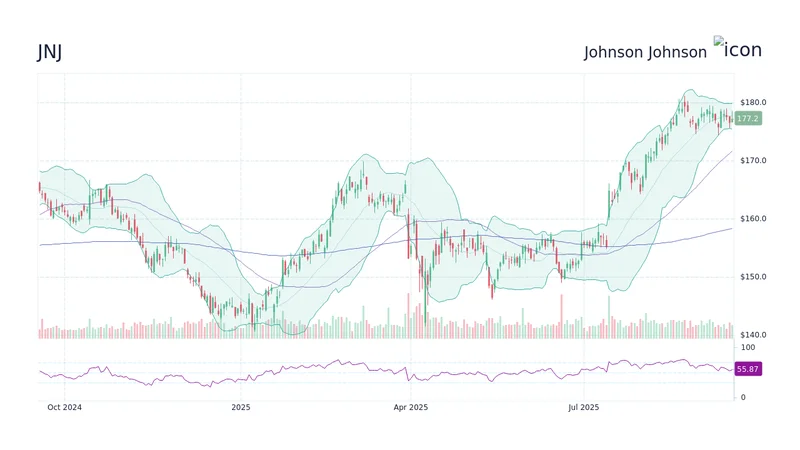
The consensus rating for JNJ stock is a "Moderate Buy." I’ve looked at hundreds of these consensus reports, and this particular flavor of rating is often a sign of institutional indecision. It’s a polite way of saying, “We don’t think it’s going to collapse, but we lack the conviction to pound the table.” This is based on ratings from 18 Wall Street analysts—or, to be more precise, 11 Buys and 7 Holds. A complete absence of "Sell" ratings is typical for a blue-chip behemoth like J&J, but the significant number of "Holds" suggests a widespread wait-and-see approach.
This caution is reflected directly in the price targets. The average target of $194.56 implies a meager 2% upside from current levels. When analysts are projecting returns that barely outpace inflation, they are signaling a profound lack of catalysts. The market, it seems, was already skeptical of J&J’s growth trajectory before its new cancer drug was slapped with the FDA’s most serious warning label.
There's also a glaring discrepancy in some of the publicly available data regarding the stock's performance. One report I reviewed claimed J&J shares had jumped about 35% since the start of the year. This is demonstrably false; the stock is actually down year-to-date. This isn't just a rounding error; it's a fundamental misreading of market sentiment that could lead an uninformed investor to a wildly incorrect conclusion. It underscores the necessity of verifying every single data point, especially in a volatile market. The reality is that Johnson & Johnson Stock (JNJ) Falters Ahead of Earnings Release as Cancer Therapy Gets Warning Label has been underperforming in a healthcare sector that is already facing significant headwinds.
The Carvykti situation is like discovering a hairline crack in the main support beam of a new skyscraper. The building is still standing, and it might even continue to function perfectly for years. But the engineers now have to account for a new, permanent stress variable. Every future projection, every safety assessment, is now viewed through the lens of that potential failure. What was once a simple calculation of revenue and profit now requires a complex new variable for risk. The question for J&J's management on tomorrow's earnings call is: have you recalculated the math, and can you show us your work?
The Signal Is Getting Noisy
Let's be clear. The Carvykti warning, in isolation, is not an existential threat to a company as diversified and massive as Johnson & Johnson. The immediate financial impact will likely be negligible. But it is a significant injection of noise into what was supposed to be a clear growth signal. The company's pharmaceutical division relies on a pipeline of next-generation drugs to offset revenue loss from older products, and Carvykti was a star player. Now, its long-term potential is clouded by uncertainty.
My analysis suggests the market's tepid enthusiasm for J&J was already pricing in a certain level of stagnation. The "Moderate Buy" rating and paltry 2% price target upside were clear indicators of that. This FDA action doesn't create a new problem so much as it validates an existing concern: a lack of clear, unimpeded growth drivers. The upcoming earnings report is now less about the Q3 numbers and more of a referendum on management's ability to navigate a suddenly more complicated future for one of its key assets. The numbers will be the numbers, but the real story will be in how they quantify this new, and very serious, risk.
Tags: jnj stock